Beginner Volleyball Drills: Basic Exercises & Practice Ideas for New Players
These beginner volleyball drills cover the fundamentals every new player needs to build real court confidence. Whether you're running volleyball drills for beginners in a youth program, putting together basic volleyball drills for a first practice, or looking for volleyball exercises beginners can actually execute without prior experience — start here. If you need volleyball drills beginners can run right away, these beginner volleyball practice drills focus on passing, setting, serving, and movement before adding tactical complexity.
Beginner volleyball drills are short, fundamentals-first reps that teach passing, setting, serving, and movement before advanced tactics. The best volleyball drills for beginners prioritize clean technique, repeatable touches, and simple progressions. Start with basic volleyball drills players can execute consistently, then layer in speed, decision-making, and game pressure over time.
Basic Volleyball Exercises to Start With
Early reps shape long-term habits. These foundational movement and control drills give new players consistent touches before adding speed and pressure.
1. Continuous Pepper
Players needed: 6-20
Setup: Pairs spread out with one ball and clear spacing lanes.
How it works: Players run pass-set-hit continuously with controlled rhythm. Start short for confidence, then increase distance as touches stabilize.
Coaching cue: Keep platform angle consistent and call every contact.
2. Hitting Footwork Lines
Players needed: 6-12
Setup: Use tape or court lines to mark approach lanes.
How it works: Players repeat 3-step or 4-step approaches with controlled arm swing timing. Add tossed balls only after rhythm is stable.
Coaching cue: Explode through the last two steps with balance.
3. 3v3 Half-Court Game
Players needed: 6-18
Setup: Play 3v3 on a reduced court with scoring.
How it works: Teams must complete three contacts before sending the ball over. Rotate groups quickly to maximize touches per player.
Coaching cue: Reward communication and controlled contacts over power.
Volleyball Passing Drills for Beginners
1. Pass-and-Freeze
Players needed: 8-14
Setup: Coach tosses or serves to passers with a visible setter target.
How it works: After each pass, coach calls freeze so players hold posture for immediate correction. Restart quickly to keep rep volume high.
Coaching cue: Freeze shoulders and platform line after contact.
2. Coach-Fed Platform Passing
Players needed: 8-14
Setup: Coach feeds balls to passers in lanes with one passing target.
How it works: Passers move to ball, set platform, and pass to target. Passers follow the ball to target, target hands ball to coach or puts the ball in the cart so coach can continuously toss balls in and reps stay high and focused.
Coaching cue: Move feet first, then lock the platform.
3. Butterfly Passing
Players needed: 10-20
Setup: Set up pass-set-catch lines on both sides of the court.
How it works: Players rotate continuously through butterfly stations. Keep transitions fast while demanding accurate first contact.
Coaching cue: Transition quickly and keep target calls early.
4. Short-Court Serve-and-Receive
Players needed: 8-16
Setup: Use half-court depth with serving and passing groups.
How it works: Rallies start from serve receive on a shortened court to increase first-contact reps. Rotate passers and servers every few balls.
Coaching cue: Read the serve early and pass to the same target zone.
Beginner Setting Drills
Use simple pattern work so players can focus on hand shape, ball trajectory, and balanced footwork before moving into faster game-tempo sets.
1. Continuous Pepper
Players needed: 6-20
Setup: Pairs spread out with one ball and clear spacing lanes.
How it works: Players run pass-set-hit continuously with controlled rhythm. Start short for confidence, then increase distance as touches stabilize.
Coaching cue: Keep platform angle consistent and call every contact.
2. Butterfly Passing
Players needed: 10-20
Setup: Set up pass-set-catch lines on both sides of the court.
How it works: Players rotate continuously through butterfly stations. Keep transitions fast while demanding accurate first contact.
Coaching cue: Transition quickly and keep target calls early.
Serving Drills for New Players
1. Target Serving
Players needed: 8-16
Setup: Place large target zones with cones on the opposite court.
How it works: Players serve to called zones in short rounds. Award points for in-target serves to keep serving intent clear.
Coaching cue: Controlled toss and finish toward the target.
2. Underhand Serving Form Drill
Players needed: 8-16
Setup: Use shortened serving lines with one ball per player.
How it works: Players serve from close range and move back only after hitting consistency targets. Focus on contact quality and direction control.
Coaching cue: Stable toss and smooth follow-through before adding power.
How to Structure a Beginner Volleyball Practice
A beginner volleyball practice works best with short drill windows and clear transitions. A typical 90-minute beginner practice:
- Warm-up (10 min): Light movement, arm circles, ball-handling warm-up
- Passing fundamentals (25 min): Platform posture - wall bumping - partner passing - moving passes
- Setting introduction (20 min): Self-setting - partner setting to a target - simple 2-person patterns
- Serving basics (15 min): Underhand mechanics - overhand introduction - serve to a target
- Simple game play (15 min): Cooperative rally or modified game with no score pressure
- Cool-down / review (5 min): One technical point per player
Use SoloStats to track passing efficiency and serving errors from your first practice. Even beginners benefit from seeing their improvement data. Build your next volleyball practice plan template.
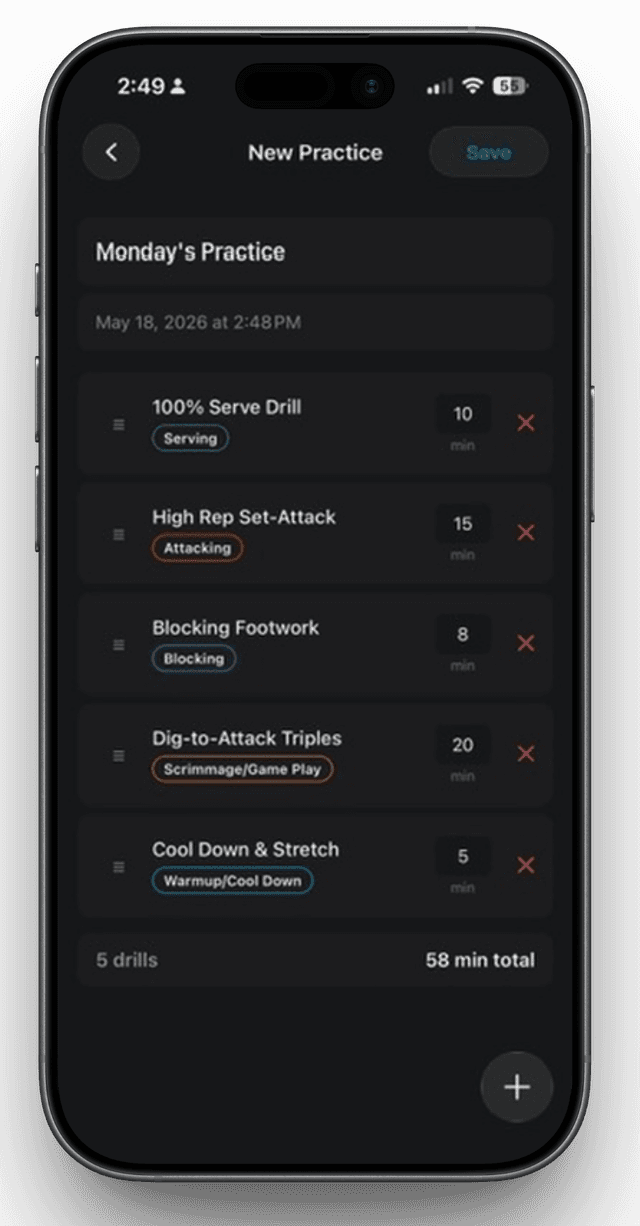
Build your practice plan with SoloCoach
Pull drills from a library, build a timed plan in minutes, and run it drill by drill with a countdown timer.
Build your first practice plan — free